

The campaign, which began in 1978, sought to rename Marathwada University in recognition of Dr BR Ambedkar’s contribution to social welfare.
A political leader once said: “Gharat nahi peeth ani magtay Vidyapeeth.” (You don’t have a loaf of bread to eat, but you want a university.)
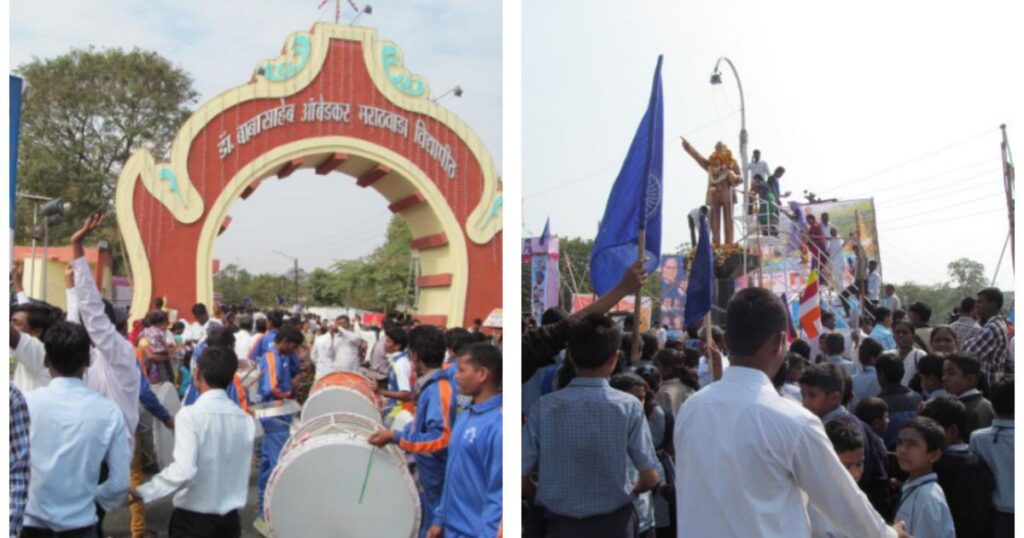
This statement was in response to the historic Namantar Andolan, a 16-year struggle waged by Dalits to rename Marathwada University in recognition of Dr BR Ambedkar, not as an act of charity to Dalits, but as a right, challenging the dominant cultural and moral order and asserting normative self-esteem. Started in 1978, it finally culminated in 1994 with Namvistaar, naming the university D Babasaheb Ambedkar Marathwada University (BAMU), portraying the “moral incapacity” of the social order, reflected in the state, to accept the dignity of Dalits, exposing the fault lines that run deep due to the psychic prevalence of conscious/unconscious caste-feudalism.
This movement is marked by several notable events – the Long March, inspired by the Chinese Long March; the famous Jail Bharo Andolan; a unique show of Dalit-Muslim solidarity; and the creation of the novel “Dalit Public.” The movement spread across Delhi, Haryana, Bihar, Madhya Pradesh, Andhra Pradesh, Tamil Nadu, and Maharashtra. Dalit literature, which asserted the aesthetic equality of being Dalit, breaking free from the traditional, graded, hierarchical, phallocentric caste system, played a crucial role in this movement, not just contributing to the literary writings, but also acting as a conscience-building tool.
From ‘reform’ to ‘radical’
This provided a further impetus to Dalit literature, in which Dalit writers crafted a new language of protest based on anger, using that which challenged the Brahmanical hegemony in the space of literature, i.e., through a defiant public spectacle, and the crafting of an antithetical, vernacular Ambedkarite counter-public that countered the Brahmanical public sphere by bypassing mainstream media, non-state actors, and academic gatekeeping.
The ballads of Shahid Vilas Ghogare, songs sung by Vitthal Umap and Shambhaji Bhagat, the poetry of Aai by Jyoti Lanjewar, and an intellectual platform like Asmita Darsha, edited by Gangadhar Pantawane, along with numerous poems and writings in the regional languages, documented this historic struggle as a “public spectacle” of anguish. Thus, Dalit literature can be seen here employing the politics of montage – dialectical montage, symbolic montage, and parataxic syntax.
Dialectical syntax may be seen in Shahir Vilas Ghogare’s lines, where he presents a contradiction: urban Dalits, who boast of staying in cities – Pune and Mumbai – saying “Jai Bhim”, yet live like the worthless. This can also be connected to the deployment of symbolic montage, where Dr Ambedkar aimed to break the shackles of caste-class-feudalism in villages and encourage Dalits to migrate to cities for their socio-economic and political emancipation. But the verses also point to the Dalits still facing atrocities based on caste, where they have to hide their caste even in the urban areas.
Throughout the song, there is an episode of Pochiram Kamble, who was well-off materially but was killed for supporting the movement and saying the words “Jai Bheem.” Thus, Ghogare puts forth a deeper understanding of the machinations of caste in urban-rural areas, whose assault continues in both tangible and intangible realms, helping in understanding the opposition and hatred to Dr Ambedkar’s name for renaming the Marathwada University. The performance of this ballad was a chaotic juxtaposition of the deployment of heterogeneous elements – vernacular language, use of abuse in the composition, and the imagery that demonstrated the undignified living of Dalits in urban areas, the continuation of caste atrocities on Dalits in rural areas, and the denial of material rights to the Dalits, despite being legal citizens, in the independent republic of caste, demonstrating a “caste world” permeated by the banality of caste-evil.
The Dalit feminist standpoint
“I have seen you
At the front of the Long March
The end of your sari is tucked tightly at the waist
Shouting, “Change the name”
Taking the blow of the police stick on your upraised hands
Going to jail with head held high…”
The above lines have been excerpted from the poem Aai by poet Jyoti Lanjewar, who foregrounds the participation of women in the Namantar Andolan, especially by portraying the image of the “labouring mother” in the famous long march of 1979. Women were not mere passive agents but active participants fighting the brutality of the state and society from the forefront. Her other collections, such as Disha and Ajuna Vadal Uthale Nahi, are agencies that evoke images of Dalit women, where these visuals correct the anomalies in history, foreground her-story, and create a political resonance. The writings of Urmila Pawar, especially Aydaan, document the impact the movement had on her as she navigated the complexities of being a Dalit woman, making and unmaking her identity.
Women like Jamnabai Appa Gaikwad, Sangeeta Deepak Pradhan, and Rukhmini Sakharam Satpute, who participated in this movement actively, represent the her-stories – portrayal of a distinct Dalit-feminist standpoint, where Dalit women, in the words of Uma Chakravarti, face “multiple patriarchies.” Later, due to the breathing space provided by the experiences of this movement, during as well as after the movement, there was a flood of writings by Dalit women, putting forth their saga, stories, and struggles in works like Jina Amucha by Babytai Kamble, Majhya Jalmachi Chittarkatha by Shantabai Kamble, Antahsphot by Kumudtai Pawade, and many more.
Thus, the Namantar Aandolan brought about a metamorphosis in Dalit literature, which rejected liberalism as orthodox piety, employed strong yet raw language, and served as the agency of historical documentation – the martyrs, such as Pochiram Kamble, Gautam Waghmare, Vilas Dhone, Janardhan Mavde, and others, were documented. In the words of George Lukacs, literature captures the totality of this struggle – the power structure and the forces and their agencies that exercise power, looking beyond subjectivity and going beyond individualistic accounts to provide a collective narrative of the struggle as a whole.