
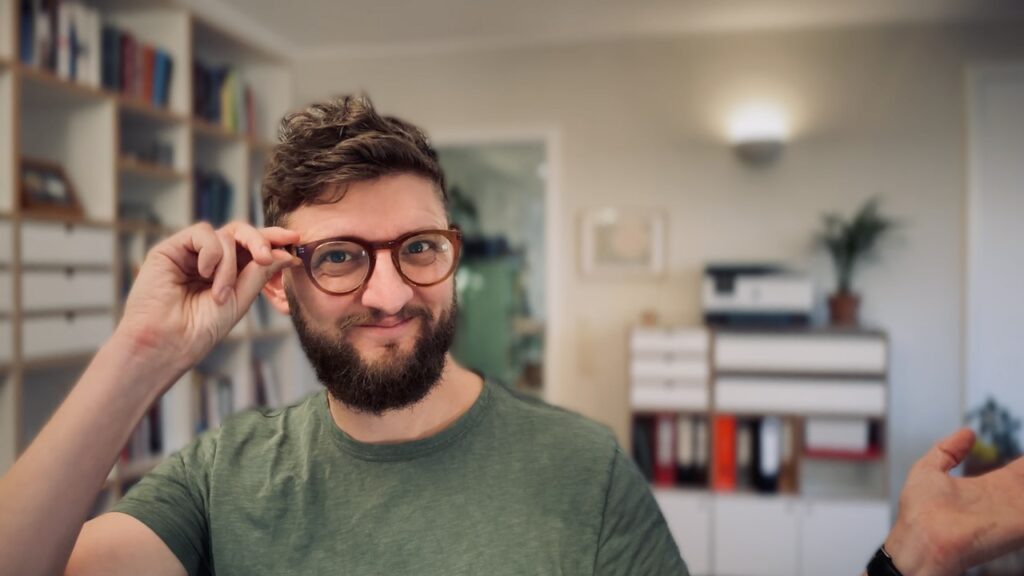
Adam Thomas brings a rare, cross-disciplinary perspective to Report for the World—one shaped as much by social care, civic tech, and creative practice as by traditional journalism. Having worked across newsrooms, philanthropy, and media funding ecosystems, Adam focuses on the often invisible structures that determine whether great journalism can survive and grow. In this conversation, he reflects on his unconventional path into journalism, what drew him to Report for the World, and why sustainability, local power, and long-term trust are central to the future of public-interest reporting worldwide.
Report For The World: Can you tell us a bit about your background—where you’re from and what brought you into journalism in the first place?
Adam Thomas: I grew up in rural Britain in a tiny village called Rippingale as the eldest of six children, in a family and community shaped by what I guess you might call economic precarity. From early on, it was pretty obvious to me that talent and effort were not the main differentiators in life, access to opportunity was, and that insight has never really left me. I came into journalism late and sideways, via social care, music, film, digital art, and civic tech rather than a newsroom pathway. Journalism is one of the few tools societies have to hold power to account, and I was drawn to the idea of democratising who gets to tell stories and whose realities are taken seriously.
What inspired you to join Report for the World, and what does our mission mean to you personally?
Report for the World stands out because it thinks of journalism holistically, as an information ecosystem, not just content with a byline and a subhead. I have spent much of my career watching strong reporting fail because the structures around it were brittle. RFW’s model recognises that local journalists embedded in their communities are best placed to do this work, if they are given time, support, and stability. For me, RFW gets that it’s not just access to information (important as that is), but access to resources, capital, and power that matters.
What specific skills or networks are you bringing to RFW, and how do you intend to leverage them to support under-covered reporting?
My greatest asset is probably my ability to work across disciplines, whether that’s translating inside an organisation between functions that don’t always speak the same language, or sectors like journalism, philanthropy, technology, and design. I have worked inside newsrooms, funders, NGOs, and start-ups, and have seen misaligned incentives can quietly undermine good intentions in all of them. I love helping journalists and civic organisations navigate funding, governance, partnerships, and growth without losing their mission. I also bring a strong understanding and set of relationships from European and global media funding, which I hope to use to unlock and design new support for the sector.
Which of RFW’s core values—like community engagement, sustainability, or local storytelling—resonates most with you, and why?
If you pushed me for one, I’d say sustainability. I think it needs to exist as the foundation of community work and journalism. It’s one of the best ways to indicate and build trust and, for me, community engagement and local storytelling only work when organisations are resilient enough to show up consistently, practising their values over time. And it’s also one of the areas that have the most potential to grow by attracting new ideas and talent to the sector.
How do you envision your role evolving here, both in terms of your own growth and in advancing the program’s impact
Initially, I began as an executive coach and advisor to Preethi (RFW’s ED), helping her deal with tough decisions and challenging circumstances (we began our work in earnest just before the USAID fallout started). Now my role is really about making the organisation more fundable and sustainable, to work on the organisation not just in the organisation.
That’s obviously partly about fundraising, but it’s also about building systems and narratives that give funders and partners and newsrooms confidence to become part of the project. To do that we need to scale trust; clearer pathways for newsroom impact, better shared infrastructure, and stronger feedback loops between journalism innovators. And while this might sound abstract, it’s absolutely essential to stay close enough to journalism to ensure our strategy remains grounded in lived reality. Luckily, that’s one of the things RFW does best!
What excites you most about working in journalism today, especially within the context of underserved communities or global challenges?
Journalism is being forced to rethink itself in public, which is uncomfortable but necessary. In underserved communities, journalism is often less about breaking news and more about continuity, relevance, and trust. I find it energising to work on models that support that kind of journalism, particularly as communities face intersecting pressures from climate, shrinking civic space, and economic instability. And I’m particularly energised when that work involves cross-border collaboration and building on new thinking from outside the space.
Can you share a powerful or memorable moment from your journalism career so far—something that reminds you why you do this work?
Sometimes it’s the really small things. Not long ago, I received an email from a small newsroom that had been a recipient of one of the micro-grants we distributed during the global pandemic, through the European Journalism COVID-19 Emergency Fund that I helped set up.
2020 was one of the hardest periods of my life, both professionally and personally. At the time, those grants felt modest and urgent, focused simply on keeping the lights on and the doors open. Years later, to hear from that newsroom that the funding helped them survive, and that they have since grown into a nationally relevant outlet with a team and a future, meant a great deal. It’s a reminder that the impact of this work is often delayed and invisible at first. The most meaningful outcomes in the support that organisations like RFW give are not always immediate or dramatic, but they endure.
Looking ahead, what kinds of stories or issues—such as climate, corruption, education, or human rights—are you most eager to help bring to light through RFW?
Anything locally grounded and sustained over time, rather than parachuted in. Anything that involves communities in the reporting. Anything that leverages interesting partnerships with libraries, or schools, or local activists, or folks traditionally excluded from the process. Anything that is prepared to push at the edge of traditional journalism in favour of shifting power.
How do you think our regional partners (like AIJC, Factum, ARIJ, etc.) can amplify RFW’s mission, and what role will you play in that collaboration
Regional partners are essential to RFW’s mission – they’re the ones closest to the story and the people writing the story. For too long, media support has operated in a top-down, intellectually superior way that has patronised communities and journalists. The time to decolonise media support is long overdue and that starts with shifting power to those affected, to those with most knowledge, to those truly innovating in the most challenging of information environments.
What message would you like to share with our community and supporters about why grassroots journalism through Report for the World matters—and how they can stay engaged?
Grassroots journalism matters because democratic erosion happens locally and incrementally. We all see it every day. Politics and technology companies are actively incentivised to divide people and keep them isolated, and journalism remains one of the few tools we have to counter that. By staying engaged with RFW, our communities and supporters are saying that we care not only about the stories that affect our own neighbourhoods, but also about the conditions that allow those stories to exist, not just here, but anywhere at all. We’re saying that journalism is a public good and an attack on journalism in one place ultimately affects all of us.