

As part of our World Press Freedom Day series, Report For The World’s Miguel Garcia continues our conversations with defenders of free expression across Latin America. In this second installment, we speak with Ana Bejarano Ricaurte, executive director of El Veinte, about the growing legal, political, and social pressures facing journalists in Colombia—and the ongoing fight to protect their work, rights, and voices.
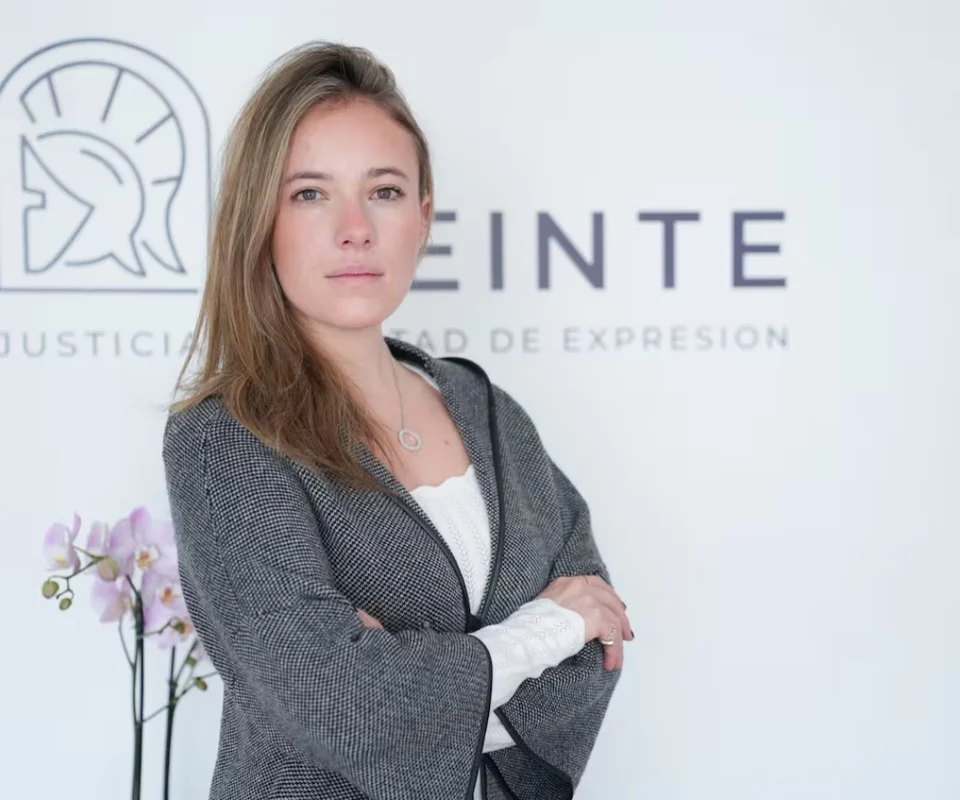
Ana Bejarano Ricaurte is a Colombian lawyer, columnist, and activist known for her work in defending freedom of expression and digital rights. She is a prominent voice in Colombian media and legal circles, particularly through her work with the web program “Los Danieles” and the organization “El Veinte” a civil society organization dedicated to defending the freedom of the press, digital rights and Legal defense of journalists and media outlets in Colombia.
Report For The World: First, to provide some context to our audience abroad, please tell us about the scope and work of El Veinte, the organization you lead in Colombia.
Ana Bejarano: Well, we’re dedicated to the legal defense of freedom of expression and to eliminating all forms of harassment against the press, especially frivolous lawsuits. We also carry out litigation prevention efforts regarding freedom of expression, supporting journalistic processes, and safeguarding journalistic work. Additionally, we aim to provide legal training for journalists so they can protect their work and, of course, produce better work.
Ultimately, our intention is to create a large network of pro-bono lawyers who will focus on the legal defense of the profession of journalists, and also on assuming the social responsibilities that this profession—our profession—has.
Historically freedom of the press in Colombia is very challenging, the threats and attacks against the press and against journalists are among violation of human rights in the country and on issues of judicial harassment and patterns of aggression, which have very significant impacts. But also the deterioration of working conditions of journalists and media workers, the precarious conditions of regional journalists.
Colombia is one of the deadliest countries in the world for practicing journalism, and that means that here, journalists systematically lose their lives and risk their lives to do this job.
But in addition to that, there’s a proliferation of threats and forms of intimidation that clearly pose a threat to the profession, the rapid increase in frivolous lawsuits against the press, and a rise in populism from various political forces that erode audiences’ trust in journalism. The emergence of social media as a platform for creating new public voices, and democratizing access to public voices, has also generated serious threats to the right to accurate and objective information—well, we already see what happens on social media—and the press’s inability to even engage with or take a firm stance against phenomena like disinformation, electoral disinformation, fake news, and other forms of distortion of reality, so it’s a very complex landscape—one in which journalists face precarious conditions, where there’s also a need to get likes, to become famous, and priorities that clearly aren’t part of the profession’s core principles.
And what about, the pressure, the discrediting of journalism, the persecution of the press—especially by the government and public officials? We’ve seen this in the United States with Trump, with Milei in Argentina, and in other cases, and Colombia hasn’t been immune to this situation. What is your take on this?
In Colombia there is a sad and long tradition of threats against the press from the executive branch and those in power. This isn’t something new, but it’s clear that President Gustavo Petro has a very aggressive discourse against the press, one of disparagement.
The president feels that the press misinterprets him, ignores him, distorts him, attacks him unfairly, and he condemns the practice of journalism in general because his style of governing and his government agenda have ended up being a populist approach that distorts the truth and rejects intermediaries.
So, he rejects any form of intermediation between himself and his electorate; that is why he resorts so frequently and unrestrainedly to social media to avoid any intermediary who might present the audience with an analysis or uncover all the systematic cases of corruption and abuse of public office.
So, it has been a very tense relationship, and the president knows very well how to use stigmatizing words, phrases, and ideas to make people distrust journalism even more—whether it’s independent or “hegemonic,” as he calls it—whether it’s from major media outlets or smaller ones. It has truly been a four-year term in which the democratic role of journalism in our system has been systematically disregarded.
Now I’d like to ask you about the state of press freedom faced by women journalists in Colombia?
The professional practice for women journalists is just as it is in any industry, in any professional field, within a patriarchal system—and obviously journalism is no exception. It is a deeply misogynistic and discriminatory profession in which there is still a significant lack of female representation and a disregard for our agency and our voice as part of the ecosystem and the public debate.
I think it has obviously improved compared to previous decades, but female journalists still face structural limitations in the way they practice their profession, not only within the newsroom, but also outside of it. So, when they’re covering stories, when they’re on the beat.
In general, women face more dangers in Colombian cities as well, but in the newsroom, as we’re seeing, they’ve recently faced many challenges and instances of discrimination based on their gender.
That’s where I wanted to go with this discussion because, with all that has come to light—the reports of sexual harassment and workplace harassment in the media. In some media outlets, abusive men have been exposed, and there are other cases, such as in the Colombian public media system, where high-ranking male officials have been accused of this type of harassment.
In addition to the precarious situation you mentioned, how do these cases of sexual harassment and workplace harassment have an effect on the freedom of the press?
Well, I believe that to the extent that women journalists cannot carry out their work on an equal footing with their male colleagues, the female voice in newsrooms and in journalistic coverage is also silenced, curtailed, and erased; that perspective is silenced as well.
And by silencing that perspective, the work that a female journalist does from her female perspective—from her place in the world—is also silenced in public debate. This is something that also happens systematically on social media, where we see that the algorithm favors misogyny; it favors and promotes it.
So, that means that women’s public voices—especially progressive ones—face far more brutal attacks in which we are sexualized, our image is distorted, we are threatened, and our families are threatened. So, this is not a form of criticism, but rather a form of silencing women’s public voices.
Sexual violence and gender-based violence end up being a form of silencing women’s public voices.
In the case of the mentions of former Colombian President Andrés Pastrana in the Epstein files, the former president himself threatened to file complaints against you for publishing a column article— What Pastrana Has Yet to Explain About the Epstein Case. That case also demonstrated, in a way, the possibility of solidarity and collaboration among victims to bring these allegations to light, and to address these cases of sexual harassment and workplace harassment within the media. Would you agree?
Yes, that has been a wonderful movement of solidarity among female lawyers, women, and writers who have come together simply to give greater visibility to this lack of information regarding the case of former President Pastrana, since it is crystal clear that he owes the country an explanation. Of course, he hasn’t been accused of anything, but those appearances warrant public explanations that he hasn’t provided. Saying he didn’t board the plane—which, by the way, apparently isn’t true because the flight records exist—isn’t enough.
He has to provide concrete explanations, and that need for the truth, I believe, is what brought together many of us journalists, individuals, and activists for press freedom, for gender equality, as well as very prominent figures who play a key role in culture, academia, journalism, and the legal field—all united under the same premise that we must agree on the necessity of having these conversations. And the more people and women join these kinds of movements, the more urgent the demand for the truth will become.
That has been wonderful—despite those attacks and those violent, aggressive reactions I’ve received, such as President Pastrana threatening to sue me, things that haven’t happened yet. At least there is some solidarity with colleagues who are concerned about this very issue.
When it comes specifically to abusive men in the workplace—especially those in public office and, let’s say, those who work in journalism—that also affects the credibility of journalism and journalists, and it affects that greatest asset we journalists have, which is credibility.
How can we work to make amends and establish best practices to repair the damage that has been done?
I think there are harassers in every industry and profession, and sexual harassment in the workplace is such a common practice that even now, in 2026, we’re still trying to wake up to the fact that it’s not acceptable, that it’s not valid, that just because it’s normal doesn’t mean it’s legitimate.
Now, I do think it’s important to differentiate because, for example, a great writer can be a harasser, a great filmmaker can be a harasser, a great journalist can be a harasser, and we have to distinguish between those worlds. The thing is, within media companies, situations are coming to light that may be systematic and that indicate measures must be taken so that women can live lives free from violence and go safely to their workplaces.
Now, how do we make amends for the harm? Well, I think the first thing to say is that the most important thing for women who experience this kind of violence is that there be truth, that there be acknowledgment—not just excuses, but forgiveness, and a genuine and organic repentance.
But we’re still a long way from the justice systems—even though the laws exist and the crimes are defined—responding sufficiently and appropriately to these phenomena.
Is there hope in the practice of journalism?
I find a lot of hope.
I have a lot of hope; I find hope in the journalists who risk their lives here in this country—not the most famous ones, but the frontline journalists, the young woman who exposes the corrupt councilman, the journalists who build the social fabric and work quietly out of love for the craft, out of love for the truth, in remote places without training, and our country is full of such examples; Latin America is full of them.
That gives me a lot of hope—finding a person who, despite all the difficulties, loves the profession and is seriously dedicated to respecting it and practicing it with integrity.
It also gives me hope to see our colleagues, the human rights defenders, who despite the difficulties of the end of international cooperation, the lack of funding, and the attacks by the powerful, continue to do the work; we keep thinking of new ways to figure out how to move a journalistic project forward, how to defend a case that is unjust.
I find hope in the judges who, after 10 years of litigating a case through different courts and bad decisions, come along and rule in favor of the press and protect what the Constitution mandates—judges who understand the social and community importance of journalism, and there are still people like that, so, despite the return of the neo-fascists, Christian fundamentalism, and a host of other things that make you say, “My God, there’s no hope,” and they want to drag us into a totalitarian state of silence.
There are a number of seeds scattered throughout the world and our country of people who believe in freedom, in respect, in social justice, in truth as a value that gives us a sense of belonging to a society. I was recently reading about a Chinese philosopher who said that “truth is the centripetal force of a society”. That when society loses the desire to seek the truth—because obviously the truth is something ethereal and has a thousand faces, and there are a thousand theories—but when we no longer even care to seek it or worry about it, society crumbles.
And I believe that even though we’re facing a very difficult time, you always find, just around the corner, the judge, the journalist, the human rights defender who keeps believing—young people, students who say, “Hey, I want to be involved, I’m interested in this, I want to defend journalists”—and if those people keep existing, there’s hope.
For more information on El Veinte go to https://elveinte.org/