

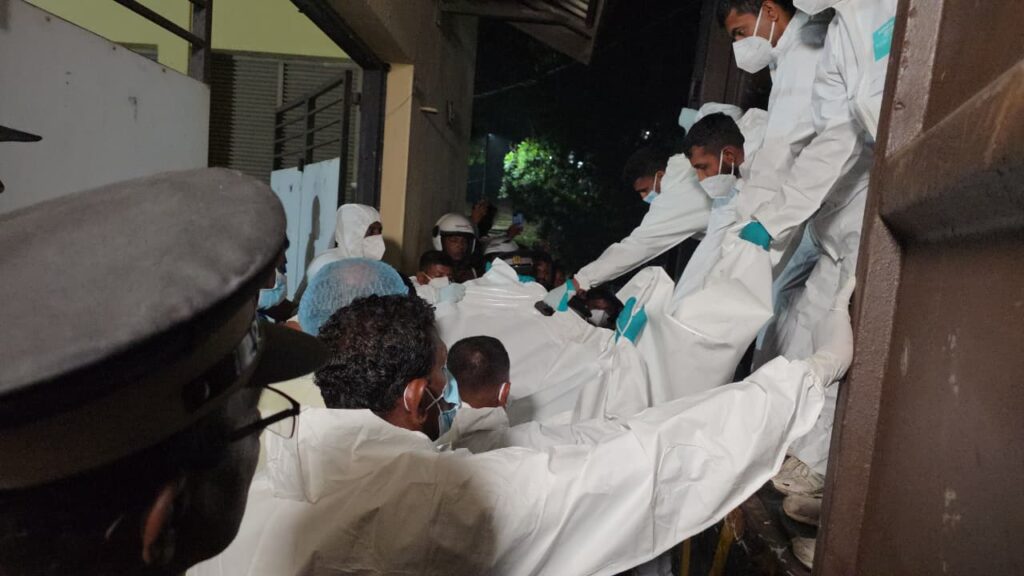
After a fast-moving maritime incident linked to the Iran-Israel-US conflict, Sri Lankan journalist Gagani Weerakoon shifted the focus of her reporting from the incident itself to the wider questions it raised about maritime security, national policy and the country’s preparedness. Here, she discusses reporting amid information gaps and how the story opened up a broader conversation.
Report for Impact : Hi Gagani, thank you for taking the time to speak with us today.
Gagani Weerakoon : Hi, thank you for having me.
Report for Impact : For someone unfamiliar with the wider conflict, how would you explain its significance for Sri Lanka?
Gagani Weerakoon : Once the conflict started, we were all worried about the economic aspect. Sri Lanka has a lot of migrant workers in those countries, so we were worried about those incidents. We also never saw the Iranian ship coming. Everyone was much more worried about the fuel part of the story because we buy a lot of our petroleum from Iran. The government was also worried about that and about what would happen to international trade.
Report for Impact : What were the biggest challenges in establishing what had happened?
Gagani Weerakoon : There was an information gap. There was no clear information available in the first few days, and even today there are some grey areas. The new government was controlling a lot of the information flow, and officials were not very comfortable talking, even off the record.
The first challenge was establishing what actually happened. There were lots of speculations. I didn’t want to get into conflicting or unverified information, so I decided to look beyond the incident and focus on something important for Sri Lanka as an island in a strategic position for international trade: how sound are we when it comes to maritime and national security?
Report for Impact : How did you verify information coming from different sides of the conflict?
Gagani Weerakoon : Journalists working on the same story started sharing whatever information they had, and some of us started fact-checking and verifying whether it was correct. It was kind of a group assignment.
Some journalists could not travel because of the fuel situation, while those who were in the affected area shared their information. We had on-the-spot reporting from them. I also reached out to people with official information and asked them to give me background information, which I could then confirm through official channels.
Report for Impact : What changed the direction of your reporting?
Gagani Weerakoon : I was initially going to report on why the vessels started coming here and whether there had been an official invitation. But while I was talking to my defence contacts, I realised this was a national security issue.
The Indian Ocean is declared a peace zone and here we had submarines coming and attacking vessels, something we had not experienced before. I started asking whether our navy was capable of carrying out surveillance and detecting those things. That led me to do follow-up stories about how we lack resources.
Report for Impact : What did you learn about Sri Lanka’s preparedness for maritime security incidents?
Gagani Weerakoon : We still lack a national policy on national security and that includes maritime security. We also don’t have a national foreign policy framework for dealing with such situations.
There was talk a few weeks later about coming up with a national security policy, but up to date it has not happened. There is still room for follow-up stories. Another major finding was that our navy does not have the modern equipment needed for undersea monitoring.
Report for Impact : Sri Lanka was also trying to maintain neutrality. What challenges did that create?
Gagani Weerakoon : It was a difficult position because we can no longer simply stick to the old non-aligned policy in today’s world. We can’t antagonise people, but we also can’t have the same old friends as our friends because they have their own interests.
The government did not issue strong positions because Sri Lanka was coming out of a major economic crisis. India and China had supported us and there were also negotiations with the US. So the government was in a very volatile position. They couldn’t say anything strongly against one side or another. At the same time, diplomats were saying that not everything has to happen in public and that diplomacy can happen behind closed doors.
The government tried its best to stick to UN conventions, even though there were loopholes.
Report for Impact : What did your reporting add to the public understanding of the incident?
Gagani Weerakoon : I think it reached the policymaking level. Think tanks approached me and were willing to give me input for follow-up stories, which is how I ended up doing a few more stories.
Other local media also started talking about maritime security and asking questions of the navy. They did not directly say they based their reporting on the CIR article, but the conversation started moving beyond the day-to-day reporting of the incident.
Report for Impact : What surprised you most during the reporting?
Gagani Weerakoon : I was surprised to find that our navy is not equipped with the sophisticated equipment needed for undersea surveillance. We have one of the biggest defence budgets in South Asia, next to India and we still don’t have the capability to track submarines. We can track planes and ships, but not submarines.
I was also surprised by the lack of national policies. We always talk about foreign policy and security policy, but I realised there wasn’t actually a comprehensive policy framework in place.
Report for Impact : How did your experience help you report quickly while avoiding unverified information?
Gagani Weerakoon : The years I have spent in the field helped. I have worked as a war reporter, so I have military contacts, and as a political reporter I have political contacts. What I lacked was the diplomatic side, but I reached out to people who knew who I should speak to.
Those channels helped me establish and verify information faster. Sometimes people who were busy with ground reporting were surprised by the questions I was asking, but they would connect me to someone else who could provide the information.
Report for Impact : How did you approach the human cost of the incident while also reporting the wider geopolitical story?
Gagani Weerakoon : I tried the human angle. I wanted to meet people and do a story, but I was not given permission. One of my colleagues who tried to go in a discreet way got into trouble with the Iranian embassy, and there were security concerns.
To avoid conflicts, the organisation decided that we should do stories around the incident rather than trying to go directly to the site. We did not have the resources to travel and meet people there, so we focused on the wider geopolitical and security questions.
Report for Impact : Thank you, Gagani, for sharing your experience.
Gagani Weerakoon : Thank you for having me.