

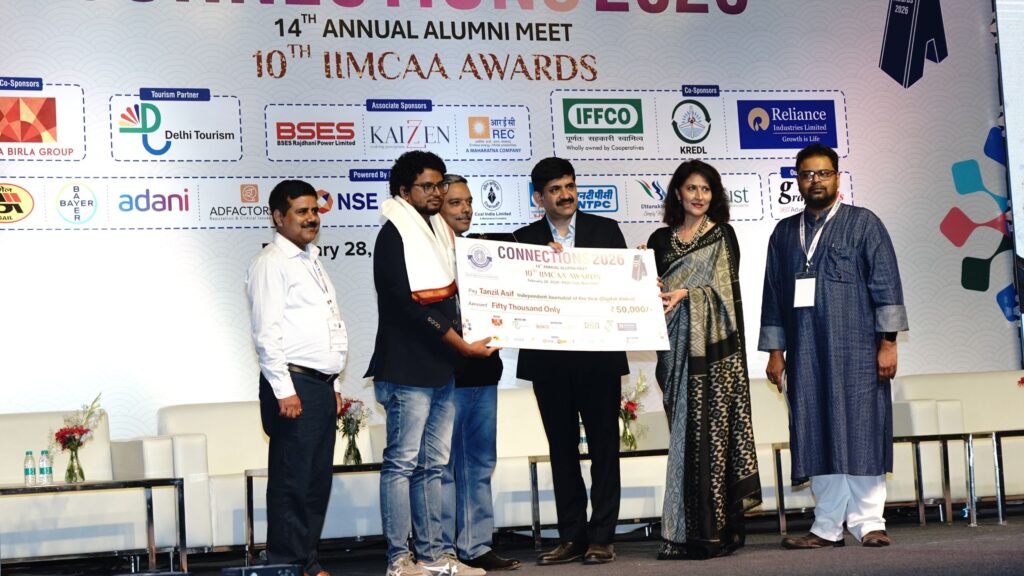
Eight years after founding Main Media, and a decade after leaving engineering to pursue journalism, Tanzil Asif has been named Independent Journalist of the Year (Digital-Video) at the IIMCAA Awards.
Tanzil Asif’s award-winning work centres on marginalised communities in Bihar — from Pasmanda Muslims to Adivasi families and farmers battling climate change — reflecting a commitment to field reporting in an era increasingly dominated by studio commentary. In this conversation, Tanzil Asif reflects on his journey, editorial philosophy, and the future he envisions for grassroots journalism in India.
You recently won Independent Journalist of the Year (Digital-Video) at the IIMCAA Awards — what did that moment mean to you, especially after eight years of building Main Media?
The Independent Journalist of the Year (Digital-Video) IIMCAA Award had a particular condition — only independent journalists who have built their own digital platforms could submit three ground reports as entries, and it clearly mentioned that commentary videos or vox pops would not be accepted. I think this is what made the award so special for me. It felt like it was meant for someone like me.
I sowed the seeds of Main Media during my college days at the Indian Institute of Mass Communication (IIMC), Delhi, in 2016. When I received the award from my college alumni association, I could see the pride in the eyes of my teachers, who had seen me grow while building Main Media. It truly felt like a full-circle moment.
You made a bold shift from engineering to journalism a decade ago. What triggered that decision, and did you ever doubt it?
I have keenly followed the news since my school days, first through magazines and newspapers, and later through video reports with the advent of various social media platforms. It was during my engineering days, around 2013, that I began to realise how little coverage the area I come from receives in the media. The Seemanchal-Kosi region in the northeastern part of Bihar has been historically backward, politically neglected, and often stereotyped, yet it remains largely media-dark.
That was when I began exploring journalism more seriously to become a voice for the region. I bought a few books on journalism and taught myself how to write pitches. Within a year or two, I started emailing my pitches to various news websites and magazines, occasionally finding success. Those early breakthroughs motivated me to push further. I began researching journalism colleges and understanding the field more deeply.
Immediately after completing my B.Tech in Electronics and Communication Engineering from Jamia Millia Islamia, New Delhi, I secured admission to Indian Institute of Mass Communication, Delhi to study journalism. There was no doubt in my mind and no looking back after that.
Your award-winning entries focused on marginalized communities in Bihar — Pasmanda Muslims, an Adivasi family affected by witch-hunting, and Makhana farmers facing climate change. Why is it important for you to center these stories?
We mostly focus on stories that rarely get covered by mainstream media or do not receive the kind of attention they deserve. The communities I reported on represent realities that are systematically ignored.
Coming from Bihar, I have seen how entire regions and communities are reduced to stereotypes or completely erased from mainstream discourse. Pasmanda Muslims, for instance, are often spoken about politically but are rarely heard. Adivasi families facing witch-hunting are treated as isolated cases rather than as reflections of deep-rooted social and institutional failures. Makhana farmers, despite contributing to a growing national and global market, are left to battle climate change with minimal support.
Centering these stories is important because journalism should document voices that are unheard, realities that are inconvenient and it should question power.
For me, telling these stories is both a professional responsibility and a personal commitment. If the media does not reflect the lives of those at the margins, it fails its most fundamental purpose.
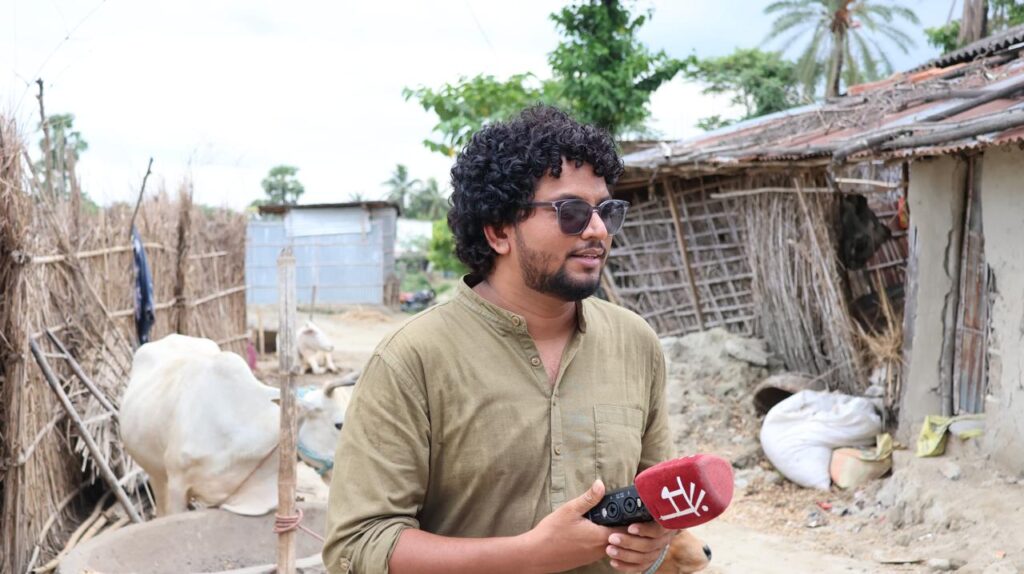
In your post, you spoke about reporting “on the ground” rather than from air-conditioned rooms. What does real field journalism mean to you today?
Recently, we have seen many well-known journalists in India leave mainstream media to build their own independent platforms. While this is a welcome trend, what is concerning is that many of them are choosing to produce commentary videos from air-conditioned rooms rather than undertake extensive investigative reporting. Some even present vox pops as ground reports. If this continues, it could redefine journalism — not just for audiences, but also for the next generation of journalists.
Commentary and vox pops can certainly be formats within journalism, but they are not substitutes for field reporting. A journalist should never dedicate their entire energy to studio-based opinions while neglecting on-the-ground work.
For me, real field journalism means physically being there where the story is unfolding. You cannot truly understand a story through press releases, social media trends, or studio debates alone.
When you report from the ground, you observe what is not being said. You notice the pauses, the living conditions, the silences, the body language. Field journalism allows you to verify facts firsthand, challenge dominant narratives, and build trust with communities.
In fact, we have exposed several instances of misinformation amplified by mainstream media and countered vilifying narratives by politicians simply by being present on the ground and reporting from ground zero.
What responsibility does digital video journalism carry in shaping public understanding, especially in regions often overlooked by mainstream media?
Video journalism has become an important and sometimes the only way to reach rural audiences in India. When stories are presented in the simplest language possible, they can be understood by an uneducated farmer, a daily wage labourer, and a homemaker alike. It also plays a huge role in shaping the understanding of young audiences, who seldom read traditional news and mostly consume video content.
Video journalism also helps present first-person narratives directly from the subject, allowing people to speak for themselves rather than being interpreted solely through a reporter’s lens.
It carries immense responsibility also because it shapes public understanding in a direct and powerful way. Video is immediate, emotional, and highly shareable. For many people it has become their primary source of news. That means the way stories are framed, edited, and presented can significantly influence how issues and communities are perceived.
In regions often overlooked by mainstream media, digital video becomes even more important. It has the ability to bypass traditional gatekeeping and bring marginalised voices directly to the audience.
Video journalism must prioritise accuracy over virality, depth over sensationalism, and context over noise. In underreported regions, one misleading video can reinforce stereotypes for years, while one honest, well-reported story can meaningfully shift public discourse.
Main Media has become known for sincere, grassroots reporting. How would you define your editorial philosophy?
Our editorial philosophy is rooted in sincerity, credibility, and ground reality.
We focus on stories that are underreported, not because they are less important, but because they are less convenient for mainstream narratives. Our approach is simple – go to the ground, verify firsthand, provide context, and let people speak for themselves. We avoid sensationalism and resist the pressure to chase trends or viral moments.
Independence means questioning power regardless of who holds it, and not allowing political or ideological bias to shape facts.
We also believe in clarity. Journalism should be accessible. If a farmer, a student, or a daily wage worker cannot understand what we are reporting, then we are failing in communication. So we aim to present complex issues in simple, responsible language without diluting their depth.
At its core, our editorial philosophy is that journalism should document reality as it is, amplify marginalised voices, and hold power accountable, all while maintaining empathy and accuracy.
You thanked your team publicly — from your Editor-in-Chief to your drone pilot. How important is collaborative storytelling in your newsroom?
Collaborative storytelling is at the heart of our newsroom. While a reporter may be the face of a story, journalism is never an individual effort. From the Editor-in-Chief who helps shape the editorial direction, to the cameraperson who captures crucial visuals, to the drone pilot who provides perspective, to the voice-over artist who brings the script to life, and the video editor who structures the narrative — every role is essential.
In digital video journalism especially, teamwork becomes even more important. A video story is not just about information; it is about visuals, sound, pacing, and context. One weak link can dilute the impact, but when everyone works in sync, the story becomes stronger and more immersive.
Collaboration also strengthens editorial integrity. When multiple people review, question, and refine a story, it reduces blind spots and improves accuracy. It ensures that we are not just telling a story, but telling it responsibly.
For me, thanking my team publicly was important because recognition should never be limited to the person holding the microphone. The credibility and depth of our reporting are built collectively, and that collective effort is what makes our storytelling meaningful.
As a newsroom partner with Report for the World, how has that partnership strengthened your ability to do impactful local journalism?
Support from Report for the World came to us at a time when we needed it the most to survive. At a moment when funding for journalism is drying up globally, this support has been crucial in helping us continue our impactful local reporting.
Through this partnership, we are working to further improve the quality of our video content. It has also given us the stability and confidence to begin producing documentary-style investigative reports from Bihar — something we had long planned but were unable to execute due to resource constraints.
This collaboration is not just financial support; it strengthens our editorial capacity and allows us to invest more time and depth into stories that truly matter.
Independent journalism often comes with financial and political pressures. What has been the toughest challenge in sustaining Main Media?
The toughest challenge in sustaining Main Media has been achieving financial stability without compromising editorial independence. When you choose to focus on marginalised communities and uncomfortable questions, commercial revenue rarely follows. Such work does not easily attract advertisers or paid subscribers.
There have been moments when resources were stretched, when we had to think carefully about travel, equipment, and even basic operational costs. Sustaining a newsroom is not just about reporting stories, it also means constantly worrying about salaries, logistics, and long-term survival.
Political pressure is another reality. When you report from the ground, live among communities, avoid extractive reporting, and challenge dominant narratives, discomfort is inevitable. Sometimes it comes in the form of online trolling; sometimes threatening calls; at times even mobs attempting to intimidate or assault us; and sometimes simply access being denied.
Navigating these pressures while ensuring the safety of the team is a constant responsibility. We have joined various journalists’ associations and regularly seek legal advice from lawyer friends to safeguard ourselves and our work.
Looking ahead, what kind of journalism do you hope Main Media will be known for in the next decade?
Looking ahead, I hope Main Media will be known for deeply reported, documentary-style video investigative journalism rooted in the ground realities of India’s most underreported regions.
Over the next decade, I want us to build a strong archive of stories that not only capture events but document social change — stories on caste, climate, labour, gender, minority rights, misinformation, vilification and rural transformation, told with depth, dignity, and context. I hope we become a platform that policymakers, researchers, and citizens turn to when they want to understand Bihar beyond stereotypes.
I also want Main Media to be known for mentoring the next generation of grassroots journalists who come from small towns and marginalised backgrounds, and who understand their communities from within.
Most importantly, I hope we are known for credibility. In an era of noise, speed, and algorithm-driven outrage, I want Main Media to stand for patience, verification, and integrity. If, ten years from now, people associate our name with trust and ground truth, that would be our biggest achievement.