

As we celebrate International Women’s Day this weekend, we will spotlight the work some of the incredible women supported by Report For The World. Today, Catalina Olate, an investigative reporter at CIPER Chile, whose reporting has helped uncover one of the most significant political scandals in the country in recent years.
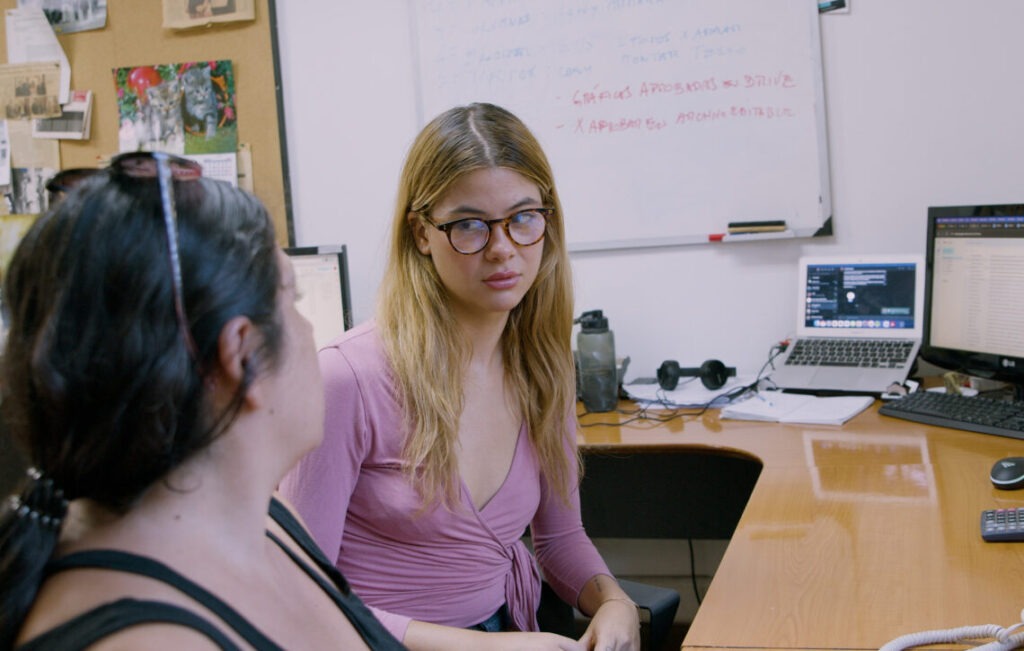
Catalina has been at the forefront of coverage of the Caso Hermosilla — a far-reaching investigation into the networks of influence surrounding powerful lawyer Luis Hermosilla. What began with leaked audio recordings and messages evolved into a complex examination of relationships between legal figures, political actors, and institutions at the highest levels of power. Through meticulous reporting, document analysis, and source development, Catalina and her colleagues traced how influence can operate behind closed doors — and what that means for transparency and public trust.
The investigation did not simply expose a single controversy. It revealed patterns: how informal networks intersect with formal power; how decisions that shape public life are sometimes negotiated out of public view; and how difficult it can be to hold entrenched systems accountable. In doing so, Catalina’s reporting reinforced a core democratic principle — that journalism must scrutinise power, not orbit around it.
Her work also underscored the risks investigative journalists face. As scrutiny around the Hermosilla case intensified, reporting itself became part of the story, raising urgent questions about press freedom and the protection of sources. In moments like these, the courage to continue reporting — carefully, accurately, and independently — becomes as important as the revelations themselves.
Catalina is supported by Report for the World, a global initiative that backs local reporters covering underreported issues in their communities. That support is more than financial. It enables time — time to verify, to cross-check, to dig deeper when a story grows more complex. It provides stability in a media landscape where investigative work is often the first casualty of shrinking budgets. And it reinforces a broader mission: that strong local journalism is essential to global accountability.
On International Women’s Day, highlighting Catalina’s work is not only about celebrating an individual achievement. It is about recognising the growing number of women leading high-impact investigative reporting in environments that are often politically sensitive and structurally unequal. It is about acknowledging the persistence required to follow difficult stories, ask uncomfortable questions, and withstand public and institutional pressure.
In this video, Catalina reflects on the process behind the Hermosilla investigation — how the story unfolded, what it took to report it, and why independent journalism matters more than ever. Her perspective offers a powerful reminder that accountability journalism does not happen by accident. It is built through patience, rigour, collaboration, and support.
At a time when trust in institutions is under strain worldwide, reporters like Catalina Olate demonstrate what it means to pursue truth with integrity. Today, we honour her work — and the essential role women journalists play in defending transparency, strengthening democracy, and ensuring that power remains answerable to the public.