

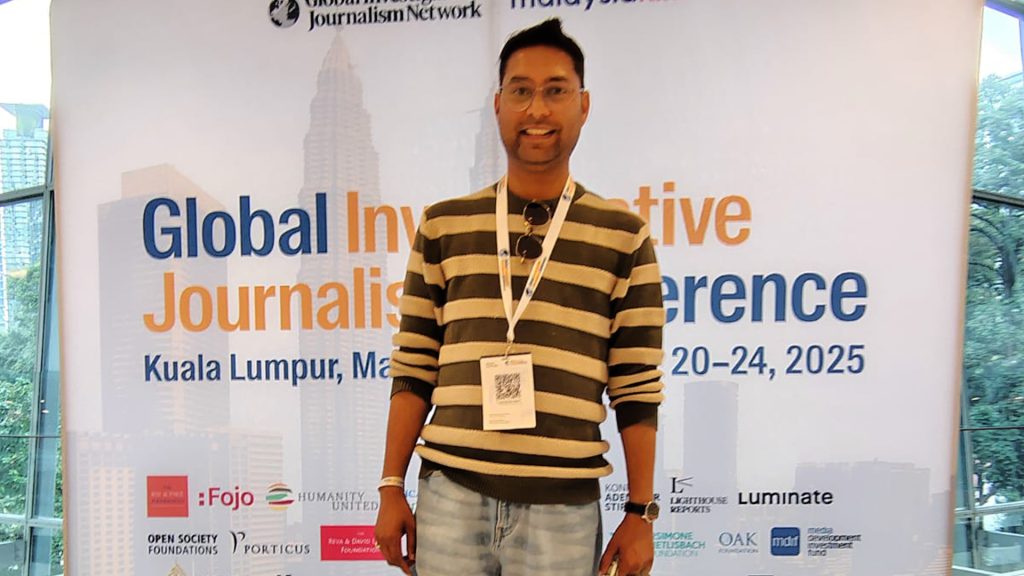
At the 2025 Global Investigative Journalism Conference, journalist Ankit Pachauri found himself representing not just The Mooknayak but the communities whose stories shape its mission. In this conversation, Pachauri reflects on why the fellowship felt like a “golden chapter” in his career, how grassroots and RTI-driven journalism from India struck a chord on the world’s biggest investigative stage, and what it means for an Ambedkarite platform to gain global recognition. From new investigative techniques to renewed determination, he shares how GIJC25 strengthened his belief that powerful journalism begins at the margins—where documentation, community voice, and truth-telling converge.
RFW: You described your GIJC25 fellowship as a “golden chapter” in your career. What moment during the conference made you feel that most strongly?
Ankit: There were many memorable moments at GIJC25, but the most impactful was the moment when The Mooknayak’s name was mentioned among journalists from around the world and our RTI-based reporting was seen as an inspiring example. At that time, I felt that despite limited resources, journalism rooted in the ground can make its identity on international platforms. When many senior journalists came to me asking how we gather information from rural and tribal communities, I felt that my reporting and struggles have truly been valued. This moment was personally a source of pride and professionally a boost to confidence for me.
RFW: The Mooknayak received global attention for its RTI-driven citizen journalism. What do you think resonated most with international journalists about this model?
Ankit: I think what impresses international journalists the most is that we put publicly available tools like RTI directly into the hands of the community. This is not just journalism but a way to make people understand their rights and bring them to the center of governance. The Mooknayak’s model seems special to them because we do reporting based on people’s documents and voices without depending on power or big institutions. Such a model is rarely seen in many countries, so this approach seemed very fresh and democratic to them.
RFW: Why is the combination of RTI tools and community participation so powerful in documenting caste and tribal injustices in India?
Ankit: Because in India, injustice is often hidden inside papers, files, and the silence of power. RTI brings out the truth from those files, and the community brings forward stories from their ground. When both come together, reporting is not just information but becomes evidence-based testimony. Especially in Dalit and tribal communities, many incidents are not even recorded due to administrative neglect. RTI fills this gap, and community participation makes that truth alive. That’s why this combination is extremely effective.
RFW: What skills or techniques from GIJC25 are you most excited to bring back to your newsroom and your on-ground reporting in Madhya Pradesh?
Ankit: Learning data analysis, OSINT techniques, and international-level verification processes at GIJC25 was the most important for me. Now I will be able to use satellite imagery, digital trails, and data sets in my reporting in a better way. This will allow stories from rural and remote areas to be presented with stronger evidence. Additionally, collaborative journalism, investigating together with multiple organizations, is a learning that I want to adopt while working in Madhya Pradesh.
RFW: Many small Indian newsrooms feel disconnected from global journalism spaces. What did your GIJC experience teach you about the role grassroots outlets like The Mooknayak can play internationally?
Ankit: GIJC taught me that impactful journalism is made not from resources, but from vision and commitment. Small newsrooms can also make their place in global discourse, provided their reporting is connected to the real problems of the people. International journalists clearly said that voices like The Mooknayak are the heartbeat of inclusive democracy, because we tell the stories of those who often get no platform. This made me understand that the role of grassroots outlets in global journalism is not just local but human and universal.
I would also like to add that at the Global Investigative Journalism Conference 2023 in Sweden, three women journalists associated with The Mooknayak participated as fellows. When our work for marginalized communities is recognized in India and abroad, it inspires us to do even better. Today, stories of the unprivileged people are finding their place globally, their issues are being brought to the forefront, and as journalists, this is the most encouraging thing for us.
RFW: What does it mean for you—personally and professionally—to represent an Ambedkarite platform on the world’s largest investigative journalism stage?
Ankit: I have previously worked in various positions in some prestigious news houses of the country’s mainstream media. But for me, this was not just a journalism opportunity but a moment of responsibility and pride. An organization working on Ambedkarite values reaching an international platform—that itself is a message. When I was standing at GIJC25, the faces of those communities were in my mind who fight daily for justice, respect, and equality. Showing them that their stories are not limited to villages but are reaching the world, this was an extremely emotional and inspiring experience for me. When I conversed with journalists from around the world there, they listened very attentively about how important and human it is to report on communities on the margins in India.
RFW: You often report from regions and communities that mainstream media ignore. How do global investigative techniques help strengthen stories rooted in local injustice?
Ankit: Exposing local injustice is not easy, especially when institutions try to hide information. The tools I got from GIJC25, like data scraping, OSINT, and advanced verification methods, will help me go deeper into such cases. Previously, we had also learned RTI and data journalism techniques in a GIJN workshop in Delhi. Now I can bring out not just the incident but also the structural failures and patterns behind it. This will make my reporting not only emotional but also extremely accurate and solid.
RFW: The Mooknayak depends on citizen reporters and community trust. After GIJC25, how do you hope to strengthen or expand that network?
Ankit: Now my goal is to provide better training to citizen reporters, information on digital security, and simple techniques for RTI filing. GIJC25 made me understand that a network is successful only when every member is capable and safe. We can organize small local workshops in which tribal and Dalit youth can be trained in digital tools and narrative building. This will strengthen The Mooknayak’s community model further.
RFW: What is one investigation or issue you’re now more determined to pursue because of the conversations you had at GIJC25?
Ankit: While talking with journalists from many countries at the conference, I realized that there is a great lack of serious, data-supported investigative journalism on tribal rights. Now I am more determined to do a long and in-depth series on forest rights, displacement, and the actual status of government schemes. A serious investigation focused on the particularly backward tribes of Madhya Pradesh—Baiga, Sahariya, Bharia, is my primary goal. In this, especially working on the Sahariya of Gwalior division and the Baiga tribe of Anuppur, Mandla, Dindori, is decided.
RFW: If you could send one message from GIJC25 back to the communities The Mooknayak serves—Dalit, Adivasi, and marginalized groups—what would it be?
Ankit: I would like to say this: The world wants to hear your story. The struggles you go through are not just local issues but part of the global debate on human rights and democracy. The stronger your voice, the more accountable the system will be. We journalists are just a bridge; the real power is you, your truth, and your right.