

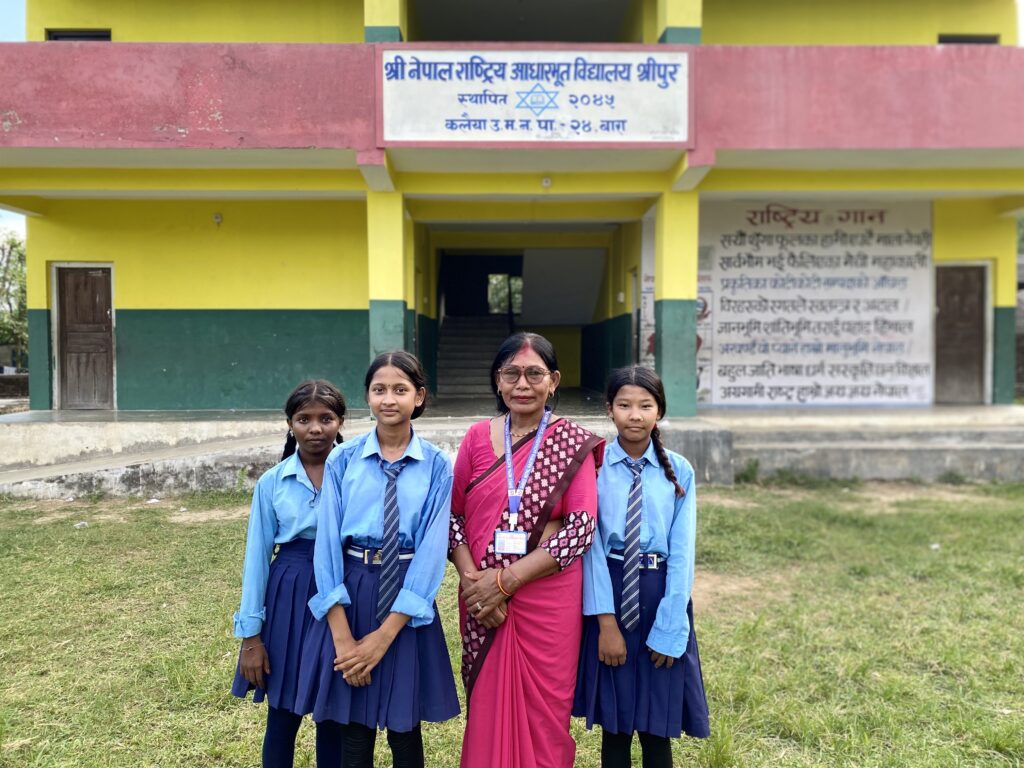
Nepal-based journalist Anita Bhetwal followed the story of Mina, an indigenous schoolteacher who took on a crusher industry over environmental and health concerns. In this conversation, Bhetwal discusses how community members helped fund the legal fight, why the case received little media attention, and the challenges faced by environmental activists working without institutional support.
Report for Impact : Hi Anita, how are you? Thank you so much for taking the time to speak with us today
Anita Bhetwal : Hi, I’m doing well, thank you. It’s a pleasure to be here.
Report for Impact : What first drew you to the story of Mina, the teacher who took a crusher industry to court?
Anita Bhetwal : The main interest is that I had developed a professional relationship with an environmental lawyer named Padam Shrestha when I worked for another media organisation. We often discussed environmental issues in Nepal, especially in the Terai region, which is really under-reported.
I had previously met Mina in Kathmandu while her case was ongoing. She looked like a very simple and calm woman, but she was aware of her rights and very determined to fight against the industrialists. She is an indigenous woman and one of the few educated people in her area. When the lawyer told me that something unusual was happening, that a schoolteacher was fighting a big industrialist and that the local police were supporting the industrialist, I became interested.
Even after she won the case, she was still being threatened by the industry. Her home is only about 200 metres from the industry, and she told me that she had to pretend she was walking or working when going to school because she was afraid. The local police also came to her school and harassed her. That attracted me to the story because I wanted to give a voice to a woman who was fighting for her rights.
Report for Impact : How was Mina able to find the resources to pursue such a major legal case on a teacher’s salary?
Anita Bhetwal : It was very interesting because I had not written in the story about how she managed economically. A teacher’s income is not enough to easily run a family, so I asked her how she managed to fight such a big case.
She told me that the villagers collected money from each family. There were about 200 families in the village. Some gave 1 rupee, some gave 10 rupees, some gave 100 rupees and some gave 1,000 rupees. The villagers collected the money and gave it to Mina, asking her to continue fighting the industrialist. So she had a lot of community backing.
Report for Impact : The industry had been operating since 2007. Why did the legal action become more urgent years later?
Anita Bhetwal : This is the same question I asked Mina. She said that, over time, people started seeing the effects of pollution. Her school is near the industry and students were being affected. People were going to hospital and suffering from allergies and asthma, especially students and older people.
She said that if she did not file the case, her grandchildren would also get diseases from the pollution. There were also homes belonging to indigenous people that had been damaged by the vibrations from the crusher. One man told me that his house was already broken because of the vibration and that if they did not raise their voices, it would become too late.
Report for Impact : How did you build enough trust with Mina for her to speak about such a sensitive issue?
Anita Bhetwal : It did not take much time to convince her because she was looking for a way to publish her own story and her own journey of fighting for her rights. I had met her about a year before, just for a normal conversation. At that time I was thinking that I might make a documentary about her because she was a schoolteacher, the whole village was supporting her and she was fighting a big industrialist. I became a fan of her courage and willpower.
When I asked her if I could report on the case, what was happening, what had happened to her, how she won the case and how she was still being harassed afterwards, she felt that she had found a medium to give her voice. The case file was already available on the Supreme Court website, so the facts and evidence were accessible. What she was not getting was public attention and support.
Report for Impact : Mina had already won the case, but the story did not receive much media attention. Why do you think that was?
Anita Bhetwal : In Nepal, cases like this happen every day. There are many environmental activists and local people who file cases against crusher industries. I even called a police officer from the same district and asked whether the crusher was still running. He told me it was closed, but he also said that in Nepal more than 90% of crusher industries are running illegally. So, from that perspective, he saw this as not a big issue or a new story.
When Mina won the case, she probably thought, ‘I won the case, now everything will be settled.’ She was very happy. But because these cases are so common, she did not get much media attention.
Also, she lived in a village area where connecting with media organizations and other welfare organizations was almost impossible. Also, she is the head teacher, so she could not miss the classes. Therefore, she did not pursue getting her case’s attention.
Report for Impact : What was Mina hoping would happen after the Supreme Court ruling?
Anita Bhetwal : When she won the case, she was hoping that she could live freely and calmly. Usually in Nepal, when the Supreme Court orders a crusher to shut down, the local government helps to shut it down. But that did not happen in Mina’s case.
She was still being threatened by the crusher owner. She was expecting not to be harassed by the local police and not to be threatened by the industry owner. After the story was published, I called Mina and she told me that the local police had stopped calling her and other villagers to the police station. She also said the crusher owner had become quiet, although I don’t know how long that will last. The lawyer I mentioned, Padam Shrestha, is also planning to file a contempt of court case.
Report for Impact : Is there institutional support for environmental activists like Mina in Nepal?
Anita Bhetwal : This is something that is lacking in Nepal. There is no organised organisation and no organised fund to support people like Mina. That is why she had to collect small amounts of money from the villagers.
If there was an organisation that could speak on her side, perhaps I would go through that side, but I had to go directly to Mina. That is also why she is frightened. She is fighting almost alone. There are individual environmentalists working on their own, but there is not much organisational support. The law and policy are also not really protecting environmentalists. There are some activists now making groups on social media, and I am also part of one of those groups to understand what is happening.
Report for Impact : What stayed with you most from the reporting process?
Anita Bhetwal : Before doing the story, I was thinking that I might get a call from the crusher people and that they might threaten me. When I contacted one of the employees of the crusher industry, I was expecting that he might threaten me. Instead, he denied threatening Mina and the local residents and wanted me to write the story from his side.
He said that the local people were harming him and had destroyed his crusher industry. I clearly explained that we would not take anyone’s side; we would follow the facts and evidence. His response was included in the story. After the story was published, I was still waiting for him to call me, but he has not contacted me again.
The villagers had described him as a violent person who had already threatened Mina, and I had heard recordings of some of those threats. That is something that has stayed in my mind.
Report for Impact : Why do stories like this matter, particularly when the people involved come from communities whose concerns may otherwise go unheard?
Anita Bhetwal : Mina belongs to an indigenous community, and she is one of the few educated women in that village. I think reporting on this issue is about giving a voice to people who do not have access to groups of educated people, environmental organisations or lawyers.
As a journalist, I would prefer not to give my opinion. I would prefer to give a voice to the people who are fighting, based on evidence and facts. Mina told me that it was the first time she was speaking to a media person and even asked me afterwards whether she had spoken correctly.
She also asked whether, if I could not come back, I could send a list of local journalists who could report on what was happening. She understood that publishing the story could give attention to the issue and perhaps make her feel safer.
Report for Impact : Thank you, Anita, for sharing your experience and taking the time to speak with us. We really appreciate your insights.
Anita Bhetwal : Thank you. It was great speaking with you.