

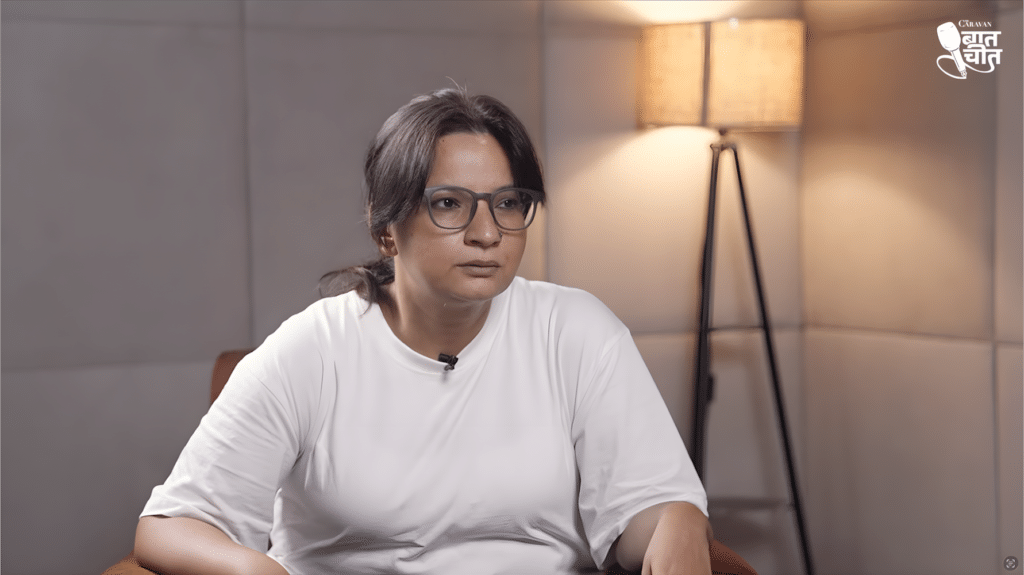
Eram Agha, a staff writer and RFW fellow at The Caravan, spent six months reporting on India’s higher education system. In this conversation, Agha discusses what prompted the investigation, how they built a nationwide network of sources and what students and academics told them about funding, curriculum, examinations and academic freedom.
Report for Impact : Hi Eram, thank you for making time to speak with us today. We’re glad to have you here.
Eram Agha : Hi, I’m doing well, thank you for having me.
Report for Impact : What prompted you to investigate India’s higher education system?
Eram Agha : When I started reporting this story, my editor wanted me to look at higher education and National Education Policy. I had just completed my NITI Aayog reporting, so it was a natural next step to look at education policy.
What prompted me was that a lot of things were happening in private universities. Professors were leaving because of research topics that were critical of the government, teachers were targeted for certain things and recordings of teachers were used out of context. Classrooms were becoming battlegrounds. I started looking at both public and private universities, but what came out most strongly was what was happening in public universities, where the teaching learning process was seeing decline along with defunding.
Report for Impact : What did your reporting reveal about the way the education system is changing?
Eram Agha : The curriculum was already being discussed in newspapers every day. You would see stories about ahistorical claims and rigorous content being removed. From what I was hearing, the concern was that education was becoming more about indoctrination than academic inquiry.
When I spoke to teachers, they told me that the National Education Policy had formalised some of these changes, with core disciplines being undermined and critical aspects being removed. I also wanted to understand what exactly the purpose of the classroom is today with several new components of skill, value and Indian Knowledge systems being given more importance than before.
Report for Impact : What did students tell you about their experience of the changing system?
Eram Agha : Student movements were being crushed. When students speak, they can force the government to respond to their demands, but that kind of movement was not happening. Then the Jantar Mantar protests happened and suddenly something changed. There was a lot of pent-up frustration that students wanted to talk about.
There were students who had lost a year because of problems with centralised examinations. Some told me they felt they could be abandoned at any time. They were saying that there were very strict rules for students while the people making decisions were not accountable for anything to anyone. They were spending time on campus but being given online courses and felt they were not getting anything in return, also FYUP had led to confusion in the academic life of students.
Report for Impact : You also reflected on your own university experience. How did that shape the questions you brought to the reporting?
Eram Agha : When I heard students telling me that their exams had been cancelled and they had to go to private universities and then come back to public universities, I thought about my own experience. I wasn’t someone who did very well academically. I wanted to start working as soon as possible, so I focused on getting my basic education and entering the workforce.
In the 2000s, I applied to universities based on my marks and got into university. I had basic subjects to study and a plan that I pursued. It didn’t seem to me that access was so complicated. Now, I was hearing about students having to take coaching just to understand how to sit for centralized examinations. Some teachers said the examination system was a way of filtering people.
Report for Impact : You spoke to students, professors, education officials and policymakers across India. How did you build such a broad range of sources?
Eram Agha : Luckily, I was on the education beat when the NEP announcement happened in 2020, so I was part of education reporting groups where university teachers were present. You ask one person and they connect you to 10 others.
I also went to protests and gatherings where academics from different parts of India came together. Social media helped me, and earlier WhatsApp groups helped too. One person connected me with another. Some of the interviews were by phone or video call. Sometimes I spoke to three students in a day, and the sources just kept coming and even the NEP drafting committee members spoke to me on the idea behind the policy.
Report for Impact : How did you decide which interviews and case studies would make it into the final story?
Eram Agha : I also interviewed people at private universities, but then we decided to go with public universities where a lot of changes were taking place. That is where most students go and that is where you have good-quality, affordable education.
I had decided that the story was about the reduction of the core components of education and how centralisation of examinations could start filtering students. My editor wanted stronger case studies, so after the initial reporting I did another round of reporting to find stronger examples of indoctrination and the decline of core components.
Report for Impact : Was there anything that significantly changed your initial understanding of the National Education Policy?
Eram Agha : The document, when you read it, sounds like it is promising you everything. It is very well written. But the devil is in the details. It is only when you sit down with academics that they tell you what it means in practice.
For example, I had not understood what phasing out the UGC would mean. I realised that the new system could involve a loan-based model of education, where universities take loans from the government and eventually that burden falls on students through higher fees. That changed my understanding of what the policy could mean for access to education.
Report for Impact : What did you find most striking about the relationship between centralised examinations, curriculum changes and students’ futures?
Eram Agha : I kept coming back to the idea that if you remove the critical part of education, you are preparing people for a kind of cheap labour for the gig economy. If students spend less time on campus, they have less connection with the campus and less opportunity to demand better infrastructure or education facilities.
Centralising examinations also changes who gets access. Students from rural backgrounds or those who are not familiar with the technical requirements of the examination can be filtered out. Then you have an education system where students are being taught without necessarily being encouraged to ask critical questions.
Report for Impact : What was the response to the story after publication?
Eram Agha : I received feedback from members of the National Education Policy committee saying that the analysis was inaccurate. At the same time, the story resonated with teachers and families. Some people who support the BJP also told me that they were concerned about access to and the quality of education.
I would like to do a follow-up series looking at private universities, including how philanthropic funding models and foreign university campuses could affect academic freedom and research.
Report for Impact : Thank you, Eram, for sharing your thoughts with us today. We appreciate your time.
Eram Agha : Thank you for having me.