

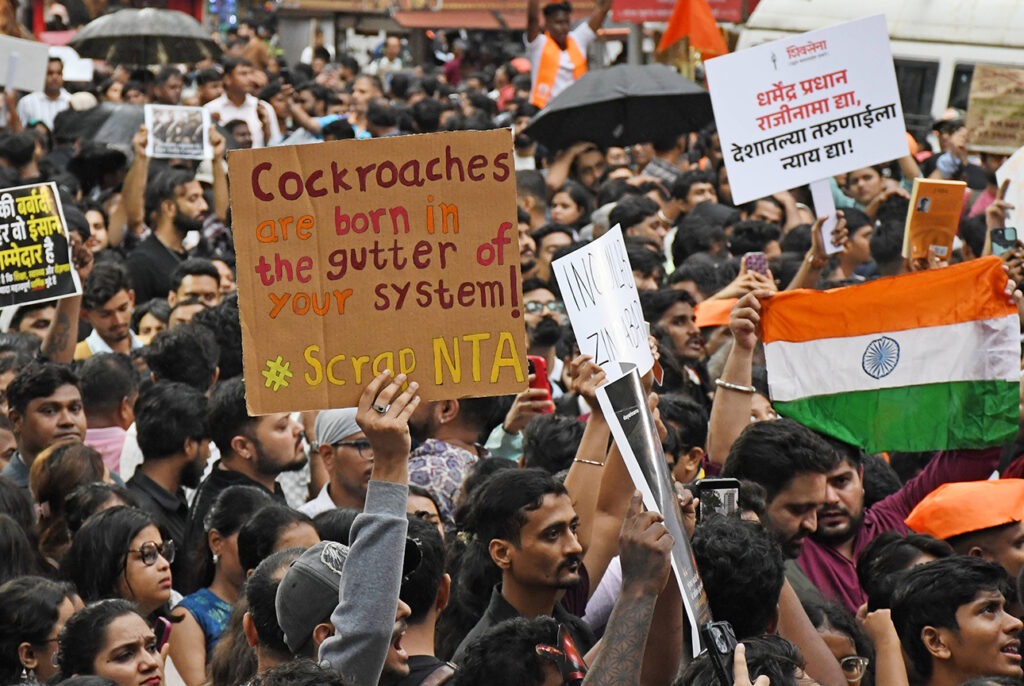
South Asia’s seen its fair share of youth uprisings. Since 2022, Sri Lanka, Bangladesh and Nepal experienced nationwide protests which resulted in changes to governments. In 2026, when the world’s largest democracy, India saw sporadic youth protests over education reforms, all eyes were on the country. What led to the protests and how did it impact the people of India?
Roman Gautam, Editor-in-Chief of the Himal Southasian talks to Report for The World.

What led to the CJP protest in India and why was there such intense crowd mobilization?
It started with a judge’s remarks calling unemployed youth “cockroaches” along with the leak of a major exam paper. A satirical online account got millions of followers, and a movement arose to demand accountability for the paper leaks and the resignation of the education minister. The movement grew because of widespread youth discontent with exam leaks and bleak prospects for their future, and the crowds on the ground grew rapidly after public backlash against security forces attacking protestors on a march to the parliament in New Delhi.
For us at Himal this was especially interesting to follow and cover after having closely covered the protests in recent years that led to changes of government in Nepal, Bangladesh and Sri Lanka.
What are your thoughts on how the media (both mainstream and new) reported the incidents?
India’s mainstream media responded with disinformation and vilification attempts aimed at discrediting the movement, as has done for years with any movement opposing the ruling government. But Indian mainstream media has lost so much credibility that a lot of people simply did not believe its coverage – something we also saw in Nepal when the Indian media parachuted in to cover the country’s September 2025 protests and nobody took them seriously. The good reporting and analysis that came out on the CJP protests was almost exclusively from a handful of small independent journalists and outlets, and organic sharing and amplification on social media allowed their work to reach a lot of people.
What 3 main challenges did regional/state-level media face when writing about the protests?
For independent outlets like Himal, resources are always a challenge, especially in terms of getting enough people on the ground to cover the protests and getting enough good information out so that the wave of disinformation from compromised media does not overwhelm the narrative. We do not have staff reporters and have to rely on freelancers from across the region and work with them to put together our coverage. Things become especially tricky when you have to separate accurate information from disinformation. Our fact-checker worked hard to ensure that we were relying on authentic and trustworthy sources while getting information from the ground.
How did you verify online falsehoods regarding the protests especially on digital media?
We knew which outlets to trust and which not to trust. We ignored non-trustworthy outlets, and with the trustworthy outlets we crosschecked information across multiple outlets/reporters and against social media posts from protestors on the ground to make sure we had our facts correct.
How can the media be a responsible stakeholder in public accountability movements like this?
The media simply has to do its job, ethically and professionally. Getting accurate and reliable information to the public is a key responsibility for the media in such movements and can be a key factor in whether they succeed or fail. For us at Himal, the priority is accuracy over speed. To bear witness to such pivotal moments is one of our essential functions as a credible Southasian media outlet, and we want to do full justice to that role.